
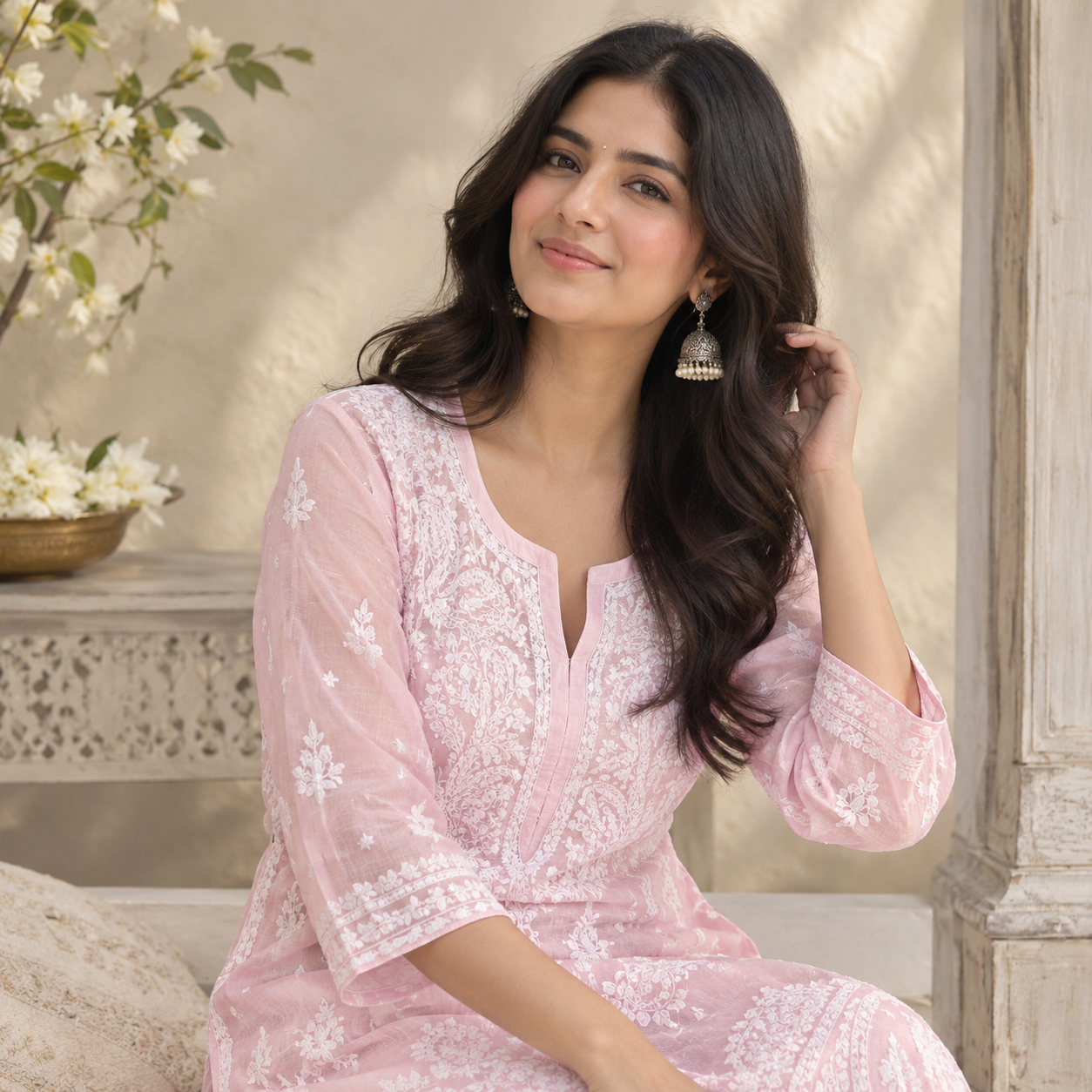
Luxury Chikankari Couture by Phabna by Shalini: Where Heritage Meets Modern Indian Elegance
Luxury Chikankari is more than delicate embroidery on beautiful fabric. It is an expression of patience, craftsmanship, heritage and timeless Indian elegance.
At Phabna by Shalini, we see Chikankari as a living art form—one that can honour its traditional roots while evolving beautifully for the modern woman. Our approach to luxury Chikankari brings together intricate hand embroidery, graceful silhouettes, refined fabrics and contemporary design to create pieces that feel both rooted and relevant.
From understated everyday elegance to sophisticated occasion wear, Phabna by Shalini celebrates the beauty of handcrafted Indian fashion through thoughtfully designed Chikankari couture.
The appeal lies in the details: the precision of every stitch, the movement of the fabric, the placement of each motif and the quiet luxury created when traditional craftsmanship meets modern design.
What Is Luxury Chikankari Couture?
Luxury Chikankari couture is an elevated interpretation of traditional Chikankari, where embroidery, fabric, design and garment construction are treated with exceptional attention to detail.
While Chikankari can range from simple embroidered garments to highly intricate handcrafted pieces, couture focuses on the complete experience of the garment.
At Phabna by Shalini, luxury is not defined merely by the quantity of embroidery. It is reflected in the way the embroidery interacts with the fabric, the silhouette and the personality of the wearer.
A couture Chikankari garment can involve:
Intricate hand embroidery
Fine traditional Chikankari stitches
Delicate floral and botanical motifs
Intricate jaali work
Premium fabrics
Carefully considered embroidery placement
Bespoke silhouettes
Detailed borders and panels
Contemporary tailoring
Refined finishing
The result is a garment that feels special not because it is excessive, but because every element has been thoughtfully considered.
Phabna by Shalini: Our Vision for Luxury Chikankari
At Phabna by Shalini, we believe Indian craftsmanship deserves a place in the contemporary luxury wardrobe.
Chikankari has an unmistakable delicacy. Its beauty can be subtle, allowing the fabric, embroidery and silhouette to work together rather than competing for attention.
Our design philosophy centres around this idea of understated sophistication.
We approach Chikankari with an appreciation for its traditional vocabulary while exploring modern ways to wear it. Flowing silhouettes, contemporary proportions, elegant layering, refined colour palettes and carefully placed embroidery allow the craft to transition effortlessly from traditional occasions to modern wardrobes.
For us, every Chikankari creation is an opportunity to preserve the romance of handcraft while giving it a distinctly contemporary expression.
The Timeless Heritage of Lucknowi Chikankari
Chikankari is one of India’s most celebrated embroidery traditions and is particularly associated with Lucknow.
Often called Lucknowi Chikankari, the craft is known for its delicate embroidery, floral motifs, intricate stitches and fine workmanship.
Historically, Chikankari became closely connected with the cultural and textile heritage of Lucknow. Traditional designs commonly draw inspiration from flowers, leaves, vines, paisleys and other organic forms.
White-on-white embroidery remains one of its most recognizable expressions, but contemporary Chikankari has expanded into a wide spectrum of colours, fabrics and fashion silhouettes.
At Phabna by Shalini, this heritage provides the foundation for a modern interpretation of luxury Indian fashion.
The objective is not to change what makes Chikankari special.
It is to allow that craftsmanship to live beautifully in today’s wardrobe.
Why Handcrafted Chikankari Is a Luxury
In an increasingly automated fashion industry, the value of something made by hand becomes even more meaningful.
Hand embroidery requires time, patience and technical skill. Every stitch is created individually, allowing the artisan to build texture, definition and character into the fabric.
This is particularly evident in intricate Chikankari.
A finely embroidered garment can contain hours of detailed workmanship before it is even transformed into its final silhouette.
This is why handcrafted Chikankari represents a different kind of luxury.
It is luxury measured not simply by price, but by:
Time
Skill
Craftsmanship
Material quality
Attention to detail
Individuality
Heritage
Design
At Phabna by Shalini, this human element is central to the appeal of handcrafted fashion.
The subtle variations and tactile quality of hand embroidery give each garment its own character.
Traditional Chikankari Stitches Behind Luxury Couture
One of the most fascinating aspects of Chikankari is its extensive vocabulary of stitches.
Different techniques create different textures, shadows, outlines and raised effects. When thoughtfully combined, they transform embroidery into a sophisticated surface design.
Ek Taar
Ek Taar is known for its fine, delicate appearance and is particularly suited to understated Chikankari.
Its refined quality works beautifully on garments where the embroidery needs to appear elegant rather than heavy.
Bakhia
Bakhia, commonly associated with shadow work, creates a distinctive interplay between the front and reverse of the fabric.
The technique can produce a soft, almost floating effect that is particularly beautiful on delicate fabrics.
Jaali
Jaali is among the most recognizable and intricate forms of Chikankari.
Its lattice-like appearance creates negative space within the embroidery, introducing lightness and architectural detail.
Fine hand-worked jaali can become one of the defining features of an exceptional Chikankari garment.
Murri
Murri creates small raised elements that add texture and dimension to embroidered motifs.
Used carefully, it can give flowers and other decorative forms a subtle three-dimensional quality.
Phanda
Phanda is a knot-based technique that adds small textured details to embroidered compositions.
It can be used alongside other stitches to build depth and character.
Tepchi
Tepchi is a running stitch commonly used to create lines, outlines and broader embroidered compositions.
Its simplicity becomes particularly effective when executed with precision.
Luxury Chikankari Fabrics: The Foundation of the Garment
Exceptional embroidery requires an equally appropriate fabric.
The fabric determines how the embroidery falls, moves, catches light and interacts with the body.
At Phabna by Shalini, the choice of fabric should always complement the design rather than compete with it.
Chikankari on Georgette
Georgette offers fluidity and movement.
Its soft drape makes it particularly suitable for:
Anarkalis
Sarees
Flowing dresses
Dupattas
Evening ensembles
Occasion wear
Fine embroidery on georgette can create an effortlessly graceful appearance.
Chikankari on Organza
Organza introduces structure and translucency.
It can be especially effective for statement sleeves, dupattas, overlays, structured garments and contemporary couture silhouettes.
The contrast between the crispness of organza and the delicacy of embroidery creates a sophisticated visual effect.
Chikankari on Chanderi
Chanderi brings an inherently elegant Indian textile character to Chikankari.
Its lightweight quality makes it suitable for sophisticated suits, sarees and festive garments where comfort and refinement are equally important.
Chikankari on Fine Cotton
Luxury does not always need shine.
Fine cotton allows the craftsmanship itself to become the focus.
The combination of breathable fabric and intricate hand embroidery creates an understated aesthetic particularly suited to daytime luxury.
Silk and Other Luxury Fabrics
Silk and richer fabrics can create a more formal interpretation of Chikankari.
They can be used for:
Evening couture
Wedding ensembles
Reception wear
Luxury sarees
Statement jackets
Festive outfits
The most important consideration is balance. The fabric should enhance the embroidery and allow the craftsmanship to remain visible.
From Design Concept to Luxury Chikankari Garment
A beautiful Chikankari garment begins long before the embroidery is completed.
At Phabna by Shalini, the design process can be understood as a relationship between concept, fabric, embroidery and final silhouette.
1. Developing the Design
The process begins with the overall vision.
The silhouette, occasion, fabric and embroidery language are considered together.
The design may incorporate:
Floral motifs
Butis
Borders
Bel patterns
Jaali
Neckline details
Sleeve embroidery
Hemline compositions
Back-panel motifs
Dupatta borders
2. Selecting the Fabric
The embroidery and fabric must work together.
A lightweight transparent fabric may call for delicate embroidery, while a more structured textile can accommodate stronger surface detailing.
3. Preparing the Embroidery Design
Traditional Chikankari production can involve transferring patterns onto fabric to guide the artisan.
The design serves as a visual map for the embroidery.
4. Hand Embroidery
This is the heart of the process.
Artisans work carefully through the motifs, creating lines, textures, knots, shadows and openwork.
The complexity of the final design depends on the combination and density of these techniques.
5. Finishing the Fabric
After embroidery, the fabric is processed and prepared for garment construction.
This stage helps reveal the finished character of the embroidery.
6. Garment Construction
The embroidered fabric is then cut and constructed into the desired silhouette.
This requires careful placement because the embroidery itself forms an important part of the garment’s design.
7. Final Quality Check
The completed garment is examined for:
Embroidery quality
Motif placement
Stitch consistency
Construction
Finishing
Fit
Overall balance
Every stage contributes to the final couture experience.
What Makes Phabna by Shalini Different?
Luxury fashion is ultimately about a point of view.
At Phabna by Shalini, that point of view is rooted in the belief that Indian craftsmanship can be sophisticated, contemporary and deeply personal.
Our approach to Chikankari focuses on creating garments that allow the craft to remain the hero while the silhouette makes the piece relevant to today’s woman.
We believe a luxury Chikankari garment should offer more than visual beauty.
It should offer:
Craftsmanship
The embroidery should reward closer inspection, revealing detail that is easy to miss at first glance.
Elegance
The design should feel refined rather than excessively ornate.
Wearability
Luxury clothing should still feel natural on the person wearing it.
Individuality
A distinctive silhouette, colour combination or embroidery composition can make a garment feel personal rather than mass-produced.
Timelessness
The strongest pieces should remain relevant beyond a single fashion season.
Bespoke Luxury Chikankari by Phabna by Shalini
Bespoke fashion changes the relationship between garment and wearer.
Instead of beginning with a fixed product, the design process can begin with the person.
A bespoke Chikankari garment can be developed around:
Preferred silhouette
Fabric
Colour
Measurements
Sleeve design
Neckline
Embroidery density
Motif placement
Border design
Dupatta
Embellishment
Occasion
This makes bespoke Chikankari particularly meaningful for weddings, celebrations, milestone events and personal collections.
A garment created around the wearer can become something more enduring than an occasion outfit.
It can become part of her story.
Luxury Chikankari Bridal Wear
Bridal fashion offers one of the most beautiful opportunities to experience Chikankari at its most elaborate.
At Phabna by Shalini, Chikankari can be interpreted for different moments within a wedding wardrobe, from intimate celebrations to grand receptions.
Possible silhouettes include:
Chikankari lehengas
Bridal sarees
Anarkalis
Sharara sets
Embroidered dupattas
Long jackets
Contemporary gowns
Bespoke bridal ensembles
For brides who prefer understated luxury, delicate embroidery and tonal colours can create an elegant result.
For those looking for greater drama, Chikankari can be combined with additional handcrafted embellishment and richer fabrics.
The beauty lies in finding the right balance for the bride.
Chikankari for Wedding Guests and Festive Dressing
Luxury Chikankari is not limited to bridal wear.
Its versatility makes it ideal for wedding guests, festive celebrations, intimate dinners and formal occasions.
A delicate Chikankari suit can create an elegant daytime look.
A heavily embroidered saree can transition into evening dressing.
A Chikankari jacket can add a distinctive layer to a contemporary outfit.
A flowing embroidered dress can bring Indian craftsmanship into a modern occasion wardrobe.
This adaptability is one of Chikankari’s greatest strengths.
Modern Chikankari Silhouettes for the Contemporary Woman
The future of Chikankari lies partly in how it is styled.
Traditional embroidery can feel remarkably modern when paired with contemporary proportions.
At Phabna by Shalini, Chikankari can be imagined beyond conventional silhouettes through:
Contemporary kurtas
Tailored trousers
Co-ord sets
Longline jackets
Draped dresses
Statement capes
Modern sarees
Structured blouses
Contemporary anarkalis
Layered ensembles
The embroidery connects the garment to Indian heritage.
The silhouette connects it to the present.
White-on-White Chikankari: The Language of Quiet Luxury
Few expressions of Chikankari are as timeless as white-on-white embroidery.
Instead of relying on contrasting colours, white Chikankari creates beauty through texture and light.
The eye discovers:
Raised stitches
Fine outlines
Shadows
Jaali
Negative space
Fabric transparency
Embroidery density
Under different lighting, the same garment can appear subtly different.
This is the essence of quiet luxury.
It does not demand attention.
It earns it.
Contemporary Colours in Luxury Chikankari
While traditional white-on-white Chikankari remains iconic, contemporary luxury fashion allows the craft to explore a broader colour palette.
Soft pastels can create a romantic aesthetic.
Neutrals can create understated sophistication.
Jewel tones can make Chikankari dramatic and evening-appropriate.
Deep colours such as black, navy, emerald and wine can provide a striking contrast against delicate embroidery.
At Phabna by Shalini, colour can become another way of bringing traditional craftsmanship into a contemporary wardrobe.
How to Style Luxury Chikankari
The beauty of luxury Chikankari is that it can carry an entire look without excessive styling.
For Daytime
Keep the accessories understated.
Consider:
Minimal jewellery
Neutral footwear
Structured handbags
Soft makeup
Simple hairstyles
For Festive Occasions
Introduce slightly stronger accessories:
Statement earrings
Pearl jewellery
Metallic footwear
Embellished clutches
Layered bracelets
For Weddings
More elaborate Chikankari can be paired with:
Traditional jewellery
Statement earrings
Metallic accents
Embellished footwear
Draped dupattas
The principle is simple:
Let the embroidery breathe.
How to Recognize Authentic Handcrafted Chikankari
When investing in luxury Chikankari, looking beyond the overall appearance can help reveal the quality of the garment.
Examine the Stitching
Look closely at the precision, texture and consistency of the embroidery.
Study the Reverse
The reverse side of the fabric can offer useful clues about how the embroidery has been constructed and finished.
Look at the Jaali
Fine handcrafted jaali should have a delicate, intricate character rather than looking flat or mechanically uniform.
Examine the Motifs
Floral and botanical motifs should feel deliberately placed and integrated into the garment.
Consider the Fabric
The quality of the base fabric should be appropriate for the level of craftsmanship.
Inspect the Construction
Luxury should extend beyond the embroidery.
Seams, hems, lining, closures and finishing all contribute to the quality of the final garment.
Why Luxury Chikankari Belongs in a Slow-Fashion Wardrobe
There is something fundamentally different about purchasing a garment because of the work invested in it.
Handcrafted clothing naturally encourages a more considered relationship with fashion.
Instead of being designed only around fast-changing trends, a beautifully made Chikankari piece can become part of a wardrobe for years.
It can be:
Worn repeatedly
Styled differently
Preserved carefully
Repaired when necessary
Passed down
Remembered through special occasions
This is where luxury becomes more meaningful.
A garment does not need to be worn once to be considered special.
The real luxury can be in owning something worth wearing again and again.
Caring for Your Luxury Chikankari
Fine embroidery requires thoughtful care.
The exact cleaning method should always depend on the fabric and garment-specific care instructions, but some general principles can help preserve delicate Chikankari.
Handle With Care
Avoid unnecessary friction against rough surfaces.
Follow Fabric-Specific Cleaning Instructions
Fine fabrics and detailed embroidery may require professional cleaning or gentle care.
Store in a Breathable Cover
Avoid long-term storage in materials that trap moisture.
Protect From Direct Sunlight
Prolonged exposure can affect delicate fabrics and colours.
Avoid Excessive Heat
When ironing or steaming is appropriate, follow the fabric’s recommended temperature and protect delicate embroidery.
Store Thoughtfully
Fold and store embroidered garments carefully to reduce unnecessary stress on the fabric and stitching.
A well-maintained Chikankari garment can remain beautiful for years.
Luxury Chikankari as Wearable Indian Heritage
The enduring appeal of Chikankari lies in its ability to bridge generations.
It belongs to India’s craft heritage, yet it does not need to remain confined to traditional fashion.
It can become a modern shirt.
A contemporary saree.
A bridal ensemble.
A flowing dress.
A statement jacket.
A bespoke occasion piece.
This adaptability allows the craft to remain alive.
At Phabna by Shalini, we see this evolution as an opportunity to bring the beauty of Indian hand embroidery into wardrobes that value craftsmanship, elegance and individuality.
The Future of Luxury Chikankari
The future of Chikankari is not about choosing between tradition and modernity.
It is about bringing them together thoughtfully.
The next generation of luxury Chikankari can explore:
Contemporary silhouettes
Bespoke fashion
Premium fabrics
International styling
New colour palettes
Limited-edition collections
Artisan-led craftsmanship
Modern bridal wear
Heritage-inspired couture
Sustainable and considered fashion
The craft remains the foundation.
Design gives it a new context.
The Phabna by Shalini Approach to Timeless Indian Luxury
At Phabna by Shalini, we believe that the most memorable garments are those that remain beautiful after the occasion has passed.
A luxury Chikankari piece should not feel dependent on a particular season or trend.
It should have enough craftsmanship to remain relevant.
Enough elegance to be worn repeatedly.
Enough individuality to feel personal.
And enough heritage to tell a story.
That is the kind of luxury we aspire to create.
The Journey of a Phabna by Shalini Chikankari Creation
flowchart LR
A[Design Vision] –> B[Fabric Selection]
B –> C[Motif & Embroidery Planning]
C –> D[Traditional Chikankari Techniques]
D –> E[Detailed Hand Embroidery]
E –> F[Finishing]
F –> G[Couture Construction]
G –> H[Quality & Fit]
H –> I[Phabna by Shalini Creation]
I –> J[Modern Luxury Wardrobe]
Frequently Asked Questions About Luxury Chikankari
What is luxury Chikankari?
Luxury Chikankari is an elevated form of Chikankari that places particular emphasis on fine hand embroidery, quality fabrics, sophisticated design, detailed finishing and the overall construction of the garment.
What is Lucknowi Chikankari?
Lucknowi Chikankari refers to the Chikankari embroidery tradition strongly associated with Lucknow and its craft heritage. It is recognized for delicate embroidery, floral motifs and a wide range of traditional stitching techniques.
What makes Phabna by Shalini Chikankari different?
Phabna by Shalini approaches Chikankari through a luxury fashion perspective, bringing traditional embroidery together with contemporary silhouettes, refined styling and an emphasis on sophisticated Indian craftsmanship.
Is Chikankari suitable for bridal wear?
Yes. Chikankari can be transformed into bridal lehengas, sarees, anarkalis, dupattas, jackets, gowns and bespoke wedding ensembles.
Which fabrics work best for Chikankari?
Georgette, organza, Chanderi, fine cotton, silk and other premium fabrics can work beautifully with Chikankari. The ideal fabric depends on the embroidery technique, desired silhouette and occasion.
Is white Chikankari still fashionable?
Absolutely. White-on-white Chikankari remains one of the most timeless expressions of the craft and fits particularly well with the modern quiet-luxury aesthetic.
Can Chikankari be worn for modern occasions?
Yes. Contemporary Chikankari can be incorporated into dresses, jackets, trousers, co-ords, sarees, anarkalis and other modern silhouettes.
How do I care for luxury Chikankari?
Care depends on the fabric and embroidery. Follow the garment’s specific care instructions, avoid excessive friction and heat, protect the garment from prolonged sunlight and store it carefully in a breathable environment.
Experience the Art of Luxury Chikankari with Phabna by Shalini
Chikankari has survived and evolved because its beauty is not dependent on passing trends.
Its essence lies in craftsmanship.
In patience.
In detail.
In the quiet movement of thread across fabric.
At Phabna by Shalini, we celebrate that essence by bringing the timeless language of Chikankari into contemporary luxury fashion.
Every carefully considered silhouette creates a new context for the craft. Every intricate embroidered detail carries forward a tradition of Indian artistry. And every garment offers the possibility of becoming something more enduring than an occasion outfit.
A piece of craftsmanship. A reflection of individuality. A celebration of Indian heritage.
That is the beauty of luxury Chikankari by Phabna by Shalini.
About Post Author

equidem
nascetur ridiculus mus.